The AECO industry is not going through a BIM revolution. It is going through an information revolution.
This distinction matters — because most of the technology changes happening right now are symptoms of a deeper shift, not causes. ISO 19650, 4D and 5D integration, AI on site, digital handover, digital twins — these are all manifestations of one underlying change in how the industry thinks about its work.
The shift is away from producing drawings and models toward managing reliable information across the full lifecycle — from the first design decision to the last maintenance cycle of a building that may stand for 50 years.
Eight major shifts define where the industry is heading in 2025–2026. Each one is not a passing fashion — it is a structural change in how AECO professionals work, how clients specify projects, and how value is created and maintained across the full asset lifecycle. Understanding them — and the connections between them — is essential for any AECO professional working on complex projects today.
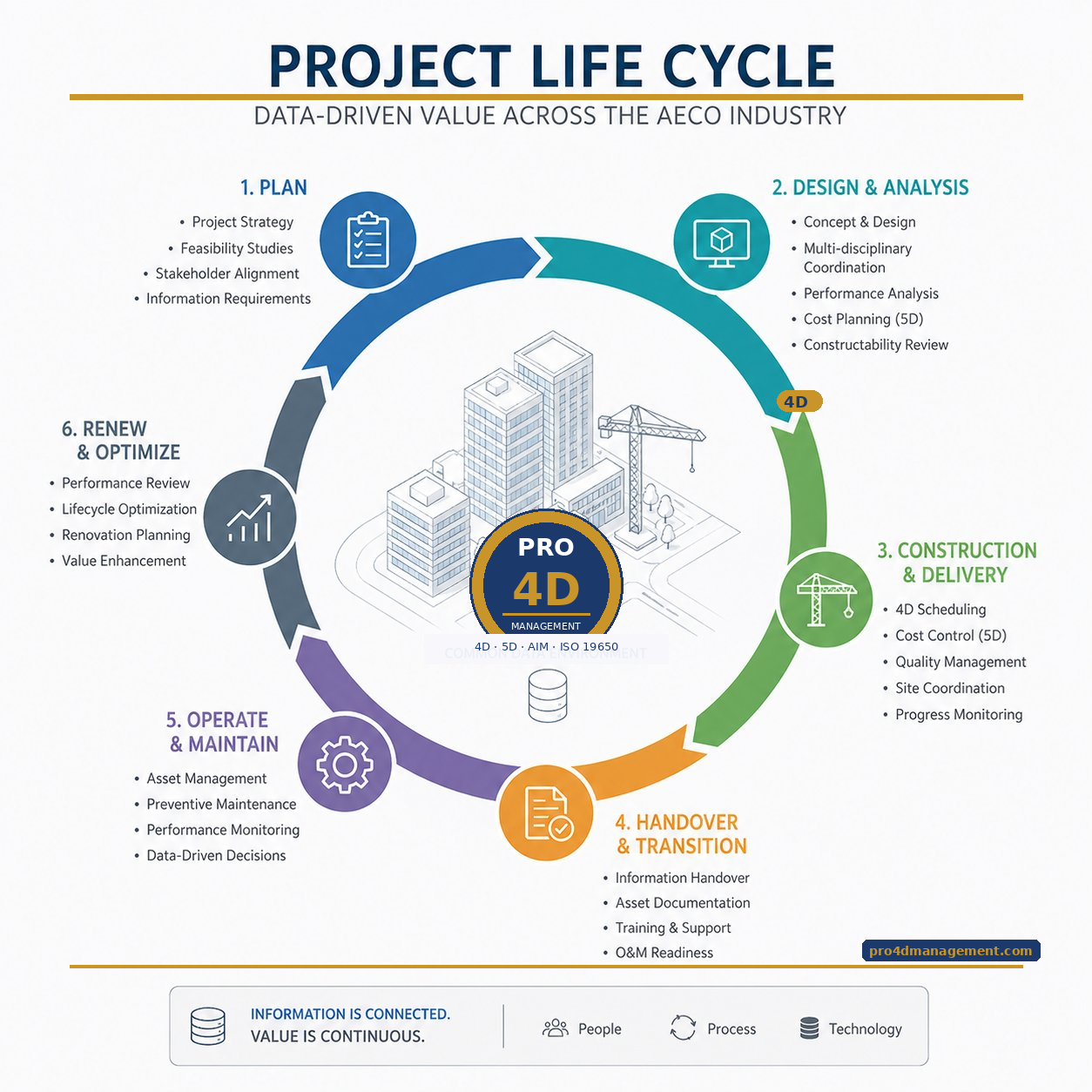
Design Is Becoming More Data-Driven
Design teams are no longer only producing geometry. The focus is shifting toward structured information — where every element in the model carries the data needed for the next stage, not just the dimensions needed for the current drawing.
This includes parametric workflows, where design parameters drive model geometry and information simultaneously; early-stage analysis, where sustainability, energy performance, and cost are evaluated at concept stage rather than at completion; and data consistency, where the same information is not re-entered at each project stage but flows forward from its origin.
The practical implications are significant. A design team working in this way is not producing drawings — it is building an information asset that will serve the project through construction and into operations. The model becomes a decision platform, not a drafting tool.
Industry context: The shift toward data-driven design is accelerating on large government and infrastructure projects globally — where clients are increasingly specifying information requirements at project inception rather than accepting whatever the design team produces.
ISO 19650 Information Management Becoming Mainstream
ISO 19650 is moving from a specialist standard referenced by BIM consultants to a contractual requirement referenced by clients, government agencies, and procurement frameworks. The industry is experiencing this transition in real time — across the industry.
More clients are now asking for Common Data Environment workflows, document naming standards, Exchange Information Requirements, and structured deliverables. The reason is increasingly clear from project experience: poor information management creates delays even when the design is technically correct.
"Poor information management creates delays even when the design is technically correct. A project can have excellent engineering and still fail at coordination because teams are working from different versions of the same document."
The proposed 2026 revision to ISO 19650 — presented at the BSI and NIMA joint webinar in February 2026 — reinforces this direction. The revision moves the standard away from geometry targets and BIM models as its central concept, toward information management as a governance framework for the full asset lifecycle. Design, construction, and operations are no longer treated as separate phases — they are milestones in a single continuous process.
Design Is Becoming Construction-Aware
The gap between design and construction is one of the most persistent sources of cost and time overruns on complex projects. The industry is increasingly recognising that this gap is not inevitable — it is the result of design processes that do not account for how buildings are actually built.
Constructability, prefabrication, modular coordination, and logistics planning are entering the design process at earlier stages. Design for Manufacture and Assembly (DfMA) is growing as a methodology. The coordination between design information and construction requirements is becoming a design-stage activity rather than a construction-stage discovery.
In information management terms, this means the transition from design information (LOD 300, coordination and clash-free geometry) to construction information (LOD 400, shop drawings and fabrication-ready data) must be planned from the start of a project — not treated as an automatic handover at the end of design. The information requirements for each stage must be defined at inception, so the design model is built to serve construction from day one.
Important distinction: LOD 300 and LOD 400 are both BIM 3D — they describe the geometric detail of the model. The critical shift at this transition is not geometry but information ownership, responsibility, and governance. Who is responsible for the model changes. What information is attached to elements changes. How the CDE is used changes. These are information management questions, not geometry questions.
4D and 5D Moving from Presentation to Control
For most of the past decade, 4D and 5D BIM were used primarily as visualisation and presentation tools. A 4D simulation was produced to show the client how the building would be constructed. A 5D model was used to generate an impressive cost report. Both were largely disconnected from how projects were actually managed on site.
That is changing. Contractors are increasingly using 4D and 5D as operational control tools — for sequencing decisions, risk identification, progress tracking, and cost forecasting. The simulation becomes the planning instrument. The cost model becomes the live control dashboard.
The shift is significant because it changes what 4D and 5D require from the information model. A visualisation can be produced from a partial, inconsistent model. An operational control tool cannot. When 4D is used for real sequencing decisions, the construction model must be information-complete, correctly structured, and maintained in real time. This is why the success of 4D and 5D as control tools depends directly on the quality of information management throughout the project.
The 4D and 5D correction: 4D (time and sequencing) and 5D (cost and quantities) are independent information layers added to the 3D model — not geometry levels. LOD 300 and LOD 400 are both BIM 3D. 4D and 5D are what transform the model from a coordination tool into a construction management instrument.
Site Digitisation — The Contractor Enters the Information Flow
Construction sites are becoming more digital — not in the sense of using computers, which has been the case for decades, but in the sense of being connected to the project information flow in real time.
Tablets on site connected to the live BIM model. Cloud coordination through ACC and BIM 360 workflows. Digital inspections replacing paper quality records. Real-time issue tracking where problems are logged, assigned, and resolved through the same platform that holds the project information.
The significance of this shift is not the technology — it is what it changes about the contractor's relationship to project information. Traditionally, the contractor received drawings and built from them. Information flowed from design to construction, and rarely back. The digital site changes this. The contractor becomes part of the information flow — contributing field data back into the project model, updating as-built conditions in real time, and creating the operational data that will eventually form the Asset Information Model.
This is not universal yet across the industry — but it is the direction. The projects that implement this now are building the capability that will become standard practice within three to five years.
Digital Twins and Asset Information Models
Clients are increasingly asking for more than a physically complete building at project handover. They are asking for long-term operational value — lifecycle information, maintenance-ready data, and a digital record of the asset that supports facilities management from day one.
This is driving two related but distinct developments: the Asset Information Model and the Digital Twin.
The Asset Information Model is the structured information set delivered at handover — equipment specifications, maintenance schedules, warranty records, spatial data for FM operations, compliance and commissioning certificates. It is what ISO 19650 defines as the endpoint of the information management process. It is not a handover output — it is the accumulated result of managing information correctly throughout design and construction.
The Digital Twin takes this further. Where the AIM is a structured static information model, a Digital Twin adds real-time data feeds — sensor data, operational monitoring, live performance metrics — to create a dynamic model of the building as it actually operates. The AIM is the foundation; the Digital Twin is what the AIM enables once the building is in use.
Practical implication: The handover stage is becoming as important as the design and construction stages. Clients who receive a properly structured AIM manage their assets more effectively and at lower cost for the entire building lifecycle. The gap between what is typically delivered and what is possible represents one of the most significant value opportunities in the AECO industry today.
AI Is Entering the Industry — And Information Quality Determines the Result
Artificial intelligence is entering AECO workflows — not as a single transformation, but as a set of practical tools that are beginning to reshape specific tasks: document search, clash prioritisation, schedule analysis, risk identification, report summaries, and cost anomaly detection.
According to industry data from 2026, 38% of contractors now report measurable business impact from AI — a figure that has more than doubled in one year. Early AI adopters in AECO are recovering 500 to 1,000 hours annually on tasks like scheduling, planning, and document analysis.
But the most important insight from early AI adoption in construction is this: AI only works well when project information is structured. Unstructured projects — where documents are inconsistently named, BIM parameters are poorly governed, and data exists in disconnected systems — still struggle even with the most sophisticated AI tools. The tool amplifies what it works with. Good information produces useful AI outputs. Poor information produces unreliable ones.
"AI only works well when project information is structured. This is why ISO 19650 information management and AI adoption are not separate conversations — they are the same conversation. The EIR, the BEP, the CDE: these are not compliance exercises. They are the information governance structures that make AI genuinely useful."
The Industry Mindset Is Changing
Beneath all eight shifts is a single, more fundamental change — a shift in how the AECO industry thinks about its work. The change is from a production mindset to an information mindset.
The old mindset measured success by what was produced: drawings issued, models developed, reports submitted. The new mindset measures success by what information is available, to whom, in what format, and when — and whether that information serves the project and the asset owner across the full lifecycle.
| Old Mindset | New Mindset |
|---|---|
| Drawings → | Information |
| Files → | Connected data |
| Departments → | Integrated workflows |
| Handover documents → | Lifecycle assets |
| BIM model → | Digital asset |
| Project completion → | Asset lifecycle |
This shift is not only about technology. It is about how project teams are structured, how contracts are written, how clients specify what they want, and how success is measured. The teams that understand this shift — and build their capability around it — will define best practice for the next decade.
Where the Highest Value Roles Are Heading
The eight shifts above point toward a clear evolution in the roles that will be most valuable in the AECO industry over the next five years. The highest-value positions are shifting away from tool operation — modelling, coordination, drafting — toward information governance and digital delivery strategy.
Information Manager
Defines and governs how information is created, structured, and maintained across the full project lifecycle — from EIR to AIM.
Digital Project Advisor
Guides project teams and clients on digital delivery strategy — connecting ISO 19650, BIM, 4D/5D, and AI into a coherent project approach.
Digital Delivery Manager
Manages the information flow from design through construction to handover — ensuring continuity, governance, and completeness at every transition.
Asset Information Specialist
Structures and delivers the Asset Information Model — ensuring the client receives a complete, usable digital record at project handover.
The common thread across all four roles is information — not tools. A professional who understands how information should flow, who is responsible for it at each stage, how it should be governed, and what it needs to deliver at handover, is the professional the industry most needs right now.
What This Means for AECO Professionals
The AECO industry is at a transition point. ISO 19650 is being referenced in contracts with increasing frequency. BIM adoption is accelerating on major government and infrastructure programmes. Clients are asking for digital handover. AI tools are entering project workflows.
The teams that will deliver most effectively in this environment are not necessarily those with the most advanced software. They are the ones with the strongest information foundations — consistent naming conventions, clear information ownership, structured CDEs, and EIRs that define what the asset owner actually needs from day one.
The future direction is not more BIM. It is better use of project information — from design through construction to operation.
That is where the industry is heading. And it is where the highest value will be created.
Further Reading
Explore related knowledge areas on ISO 19650 information management, the Asset Information Model, and AI-integrated project workflows across the AECO industry.
Back to Knowledge Areas